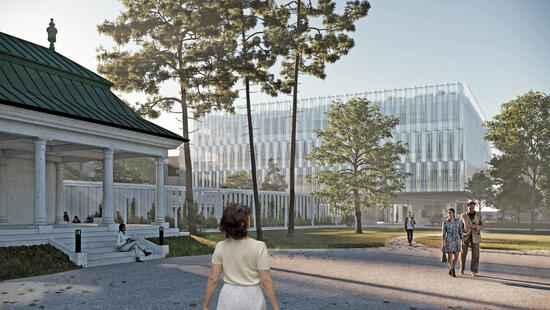


Competition entry for the two-stage architectural competition for a new pavilion of the Government Office of the Slovak Republic in the garden of the Grassalkovich Palace.
The proposal was awarded second place in a highly competitive international competition.
2nd prize in architectural competition
AOCR cooperation with INDEKS
Collective: Michal Vršanský, Michal Oborný, Andrej Drgala, Vladimír Vršanský, Branislav Kružel, David Mundil, Hana Rafajová, Jan Žemlička
The proposal is defined by the synthesis of three fundamental principles:
- The principle of geometrically redefining the north-western edge of the Lippay Garden with precision.
- The principle of locating the majority of the required above-ground building volume (the office block) outside the park's central space, or more specifically, outside the visual axis of the central façade of the National Cultural Monument – the Summer Archbishop's Palace.
- The principle of repeating the concise cubic massing of the Government Office pavilion (Ľ. Jendreják, L. Kušnír, P. Puškár, J. Šilinger). The composition introduces an already existing architectural motif in a paraphrased contemporary form.
The north-western edge of the garden is visually enclosed by a colonnade—a contemporary reinterpretation of the sala terrena typology characteristic of Baroque gardens—which reinforces the garden's axial symmetry. It creates a dignified spatial boundary and a symmetrical "frame" for the gloriette, forming a partially green screen behind which the majority of the new building's volume is concealed. The colonnade strengthens the symmetry of the Lippay Garden's landscape composition while optically completing its spatial enclosure. Its lightweight structure is softened by integrated greenery in the form of planted green bands and climbing vegetation. The colonnade itself interferes only minimally with the proposed restoration of the site and the landscape improvements beyond the competition area. Its structural module corresponds to the module of the proposed parking layout and therefore has no impact on either the number or arrangement of parking spaces.
The concept also allows for a potential future connection to Spojná Street.
Above the colonnade appears to float a delicate, undulating glazed façade of the three-storey office volume, whose reflective surface subtly fragments and animates the image of the surrounding park. The curved secondary glass skin, featuring ceramic frit printing, references the vertical articulation of the existing Government Office pavilion. The façade reinforces the pavilion-like character of the building while emphasizing minimalist expression and carefully crafted bespoke architectural detailing. It forms a restrained and harmonious backdrop to both the palace and the historic garden. The pronounced cantilever of the office volume above the access road accentuates the location of the main entrance while simultaneously providing weather protection without obstructing circulation through the site. The office block is positioned eccentrically, outside the park's central axis, thereby preserving the visual dominance of the National Cultural Monument – the Summer Archbishop's Palace.
Behind the "colonnade" lies the majority of the building's programme (all functions except the offices), making this volume largely invisible from the park and preserving the perception of the Baroque garden. The spaces on the first basement level, particularly the dining facilities, receive abundant natural daylight through a landscaped green courtyard, which also serves as an informal meeting and relaxation space. Part of the courtyard is sheltered by the cantilevered office volume, while mature trees contribute to a pleasant microclimate.
The proposal maximizes the preservation of the existing mature vegetation, particularly the horse chestnut trees along the northern edge of the site adjacent to Čajkovského Street. Through its bold volumetric and energy concept, it responds to contemporary challenges in the design of office and mixed-use buildings.